The Yunus Story: How an Anti-India Agenda Took Shape Under Bangladesh’s Interim Government
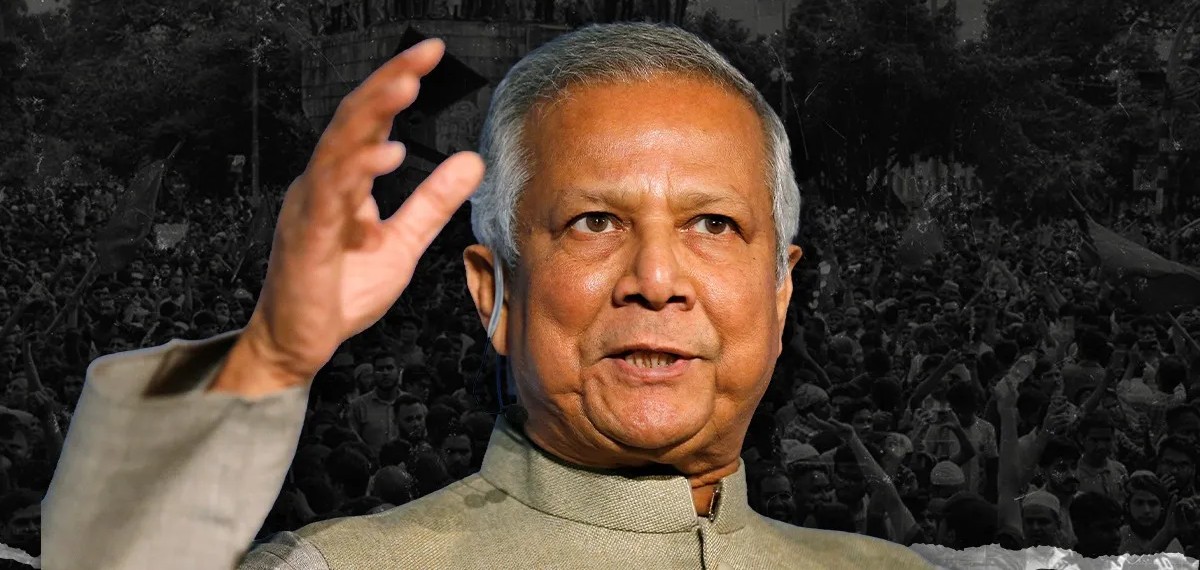
The interim government led by Nobel laureate Professor Muhammad Yunus in Bangladesh has increasingly shown signs of an anti-India agenda. His confrontational stance toward India appears to be intensifying, but its roots go back more than five decades. According to political analysts, a seemingly minor personal grievance dating back to 1972, shortly after Yunus returned from the United States, gradually evolved into a long-standing anti-India outlook.
From Model Economy to Political Turmoil
As recently as 2023, Bangladesh was being cited globally as a model of economic development. However, by the end of 2025, the country has slipped into a phase of political instability, violence, and internal unrest.
What began as a student movement in August 2024 has since spiraled into widespread chaos, marked by killings and disorder. Amid this turmoil, the interim administration headed by Professor Yunus has come under scrutiny for pushing a narrative that critics describe as anti-India.
Rising Anti-India Rhetoric
Observers point to a series of actions and statements that have fueled concerns:
- Efforts to strengthen military ties with Pakistan and China
- Remarks related to the security of India’s northeastern states
- Repeated emphasis on sensitive issues such as water sharing
- Calls for the extradition of former Prime Minister Sheikh Hasina
These moves suggest a pattern. Analysts are divided on whether Yunus’s stance is merely a political strategy to maintain relevance or part of a broader geopolitical play involving global power centers.
A Political Thriller in the Making
Despite being an economist by training, Yunus’s political journey in Bangladesh has been marked less by economic reform and more by controversy surrounding India. Investigations reveal that his resentment toward India dates back to the very beginning of his public life.
When Yunus returned to Bangladesh in 1972, shortly after independence, universities invited academics of Bangladeshi origin from across the world to return home. Yunus reportedly expected a prestigious position at Dhaka University, but the role offered to him by then leader Sheikh Mujibur Rahman fell short of his expectations.
The Seed of Resentment
Sheikh Mujibur Rahman’s close relationship with India deeply influenced Yunus’s perception. Yunus allegedly linked his disappointment at Dhaka University to India’s influence and began associating his professional setback with New Delhi’s role in Bangladeshi politics.
From that point onward, Yunus viewed Mujib as an adversary and increasingly aligned himself with Major Ziaur Rahman, Mujib’s political rival. His association with the Bangladesh Nationalist Party (BNP)—known for maintaining distance from India—also began during this period.
The 1974 Famine and Growing Hostility
According to former Bangladeshi diplomat B.Z. Khasru, author of “Hasina, Yunus and the United States: The Power Struggle for Bangladesh”, Bangladesh faced a devastating famine in 1974. During this crisis, Yunus reportedly encouraged fellow academics to openly criticize the Mujib government.
Mujib’s pro-India image continued to bother Yunus, who believed the Prime Minister was using India to remain in power. During this time, Yunus began conceptualizing what would later become the Grameen Bank, a project that brought him global recognition.
Proximity to Western Power Centers
With the success of the Grameen Bank, Yunus drew closer to influential circles in the United States and Europe. Strategic experts suggest that the US deep state began viewing him as a reliable figure in shaping future Asian geopolitics.
After receiving the Nobel Peace Prize, Yunus’s global stature grew significantly. Reports indicate that Washington explored the idea of projecting Yunus as an alternative to Bangladesh’s two dominant parties—the Awami League and the BNP.
Tensions With Sheikh Hasina
India, however, opposed the idea of installing a “third political force” in Bangladesh, arguing that such interference could destabilize the country and empower extremist elements. While this stance strained India-US discussions, it reportedly angered Yunus even more.
Yunus maintained close contact with the BNP, the Awami League’s staunchest opponent. His first direct political confrontation with Sheikh Hasina occurred during the 2007–08 military-backed interim government, when Yunus briefly entered active politics.
He even launched a political party in 2007 and contested elections with BNP support, but the Awami League emerged victorious. Relations between Hasina and Yunus deteriorated sharply thereafter.
The Grameen Bank Controversy
The Hasina government later removed Yunus from his position as head of the Grameen Bank, accusing him of exploiting the poor. Despite pressure from the United States to amend regulations in Yunus’s favor, Hasina refused to back down.
Political observers believe Yunus once again linked this setback to India’s influence over the Hasina government.
From 1972 to the Present
Following these events, Yunus maintained a low profile for several years, spending much of his time in the United States. His long-standing resentment resurfaced dramatically in 2024, when mass protests forced Prime Minister Sheikh Hasina to flee Bangladesh and seek refuge in India.
With Yunus appointed as the head of the interim government, critics argue that his anti-India stance has not only persisted but intensified, shaping policy decisions and public rhetoric.
A Growing Concern
What began as a personal grievance in 1972 has, over five decades, evolved into a significant political narrative. Under Professor Muhammad Yunus’s interim leadership, India-Bangladesh relations face renewed strain, raising concerns about the future of regional stability in South Asia.