
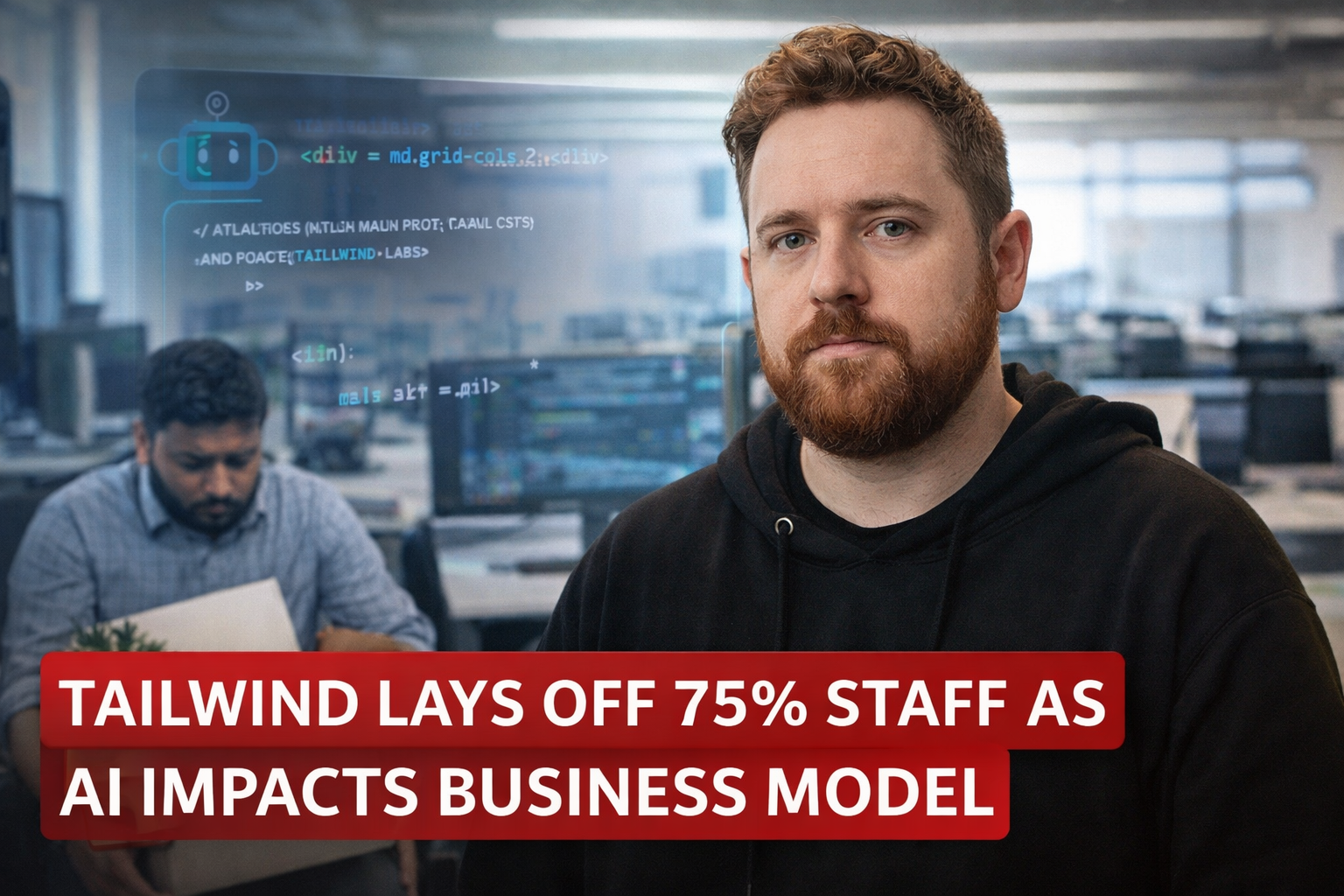
Tailwind Labs, the company behind the popular utility-first CSS framework Tailwind CSS, has laid off nearly 75 percent of its engineering workforce, even as its software continues to see explosive global adoption. The sudden job cuts highlight a growing challenge faced by open-source companies in the age of artificial intelligence.
AI Usage Soars, Revenue Crashes
Founder and CEO Adam Wathan revealed that Tailwind CSS is now being downloaded around 75 million times every month, largely because AI coding tools and assistants automatically generate Tailwind-based code for developers. While this has boosted usage, it has severely damaged the company’s revenue model.
According to Wathan, traffic to Tailwind’s official documentation — the primary channel through which users discovered its paid products — has dropped by about 40 percent since early 2023. As a result, company revenue has fallen by nearly 80 percent, despite Tailwind being more popular than ever.
“The painful truth is that 75% of our engineering team lost their jobs because of the brutal impact AI has had on our business,” Wathan wrote in a public post. He explained that AI tools bypass documentation entirely, cutting off the conversion funnel that once sustained Tailwind’s commercial offerings.
Broken Business Model in the AI Era
Tailwind Labs operates on a hybrid model: the core CSS framework is free and open source, while revenue comes from paid products such as premium UI components, templates, and developer tools. However, as AI agents generate Tailwind code without directing users to official resources, fewer developers are discovering or purchasing these paid add-ons.
“The docs are the only way people find our commercial products,” Wathan said. “Without customers, we can’t afford to maintain the framework long-term.”
Although he expressed interest in developing AI-optimized documentation, Wathan admitted that the company currently lacks the resources to experiment, warning that such efforts could further reduce human traffic.
Industry Reacts to Open-Source Crisis
The layoffs have sparked intense discussion across the tech community about the sustainability of open-source businesses in an AI-driven world.
Narayan Babu, Vice President at Zeta, described the situation as “sad but logical,” noting that few founders could have anticipated such rapid disruption. Meanwhile, Michael Kove of Kove Consulting argued that selling pre-built components is an increasingly fragile model, especially when layered on top of free open-source software.
Growth Without Stability
Despite the workforce reduction, Tailwind CSS continues to grow rapidly in adoption. However, Wathan acknowledged that usage growth and financial stability are now completely disconnected, raising difficult questions about how open-source companies can survive as AI reshapes developer workflows.
The Tailwind episode may prove to be an early warning for many developer-focused startups navigating the unintended consequences of AI-driven automation.